Contents
Imagine swapping 5 ETH to USDC. On one DEX, the pool is shallow and the price slips. On another, fees are higher. A DEX aggregator checks both—and many more—then executes the swap where your net outcome is strongest. It’s metasearch for on-chain trades.
How DEX Aggregators Work
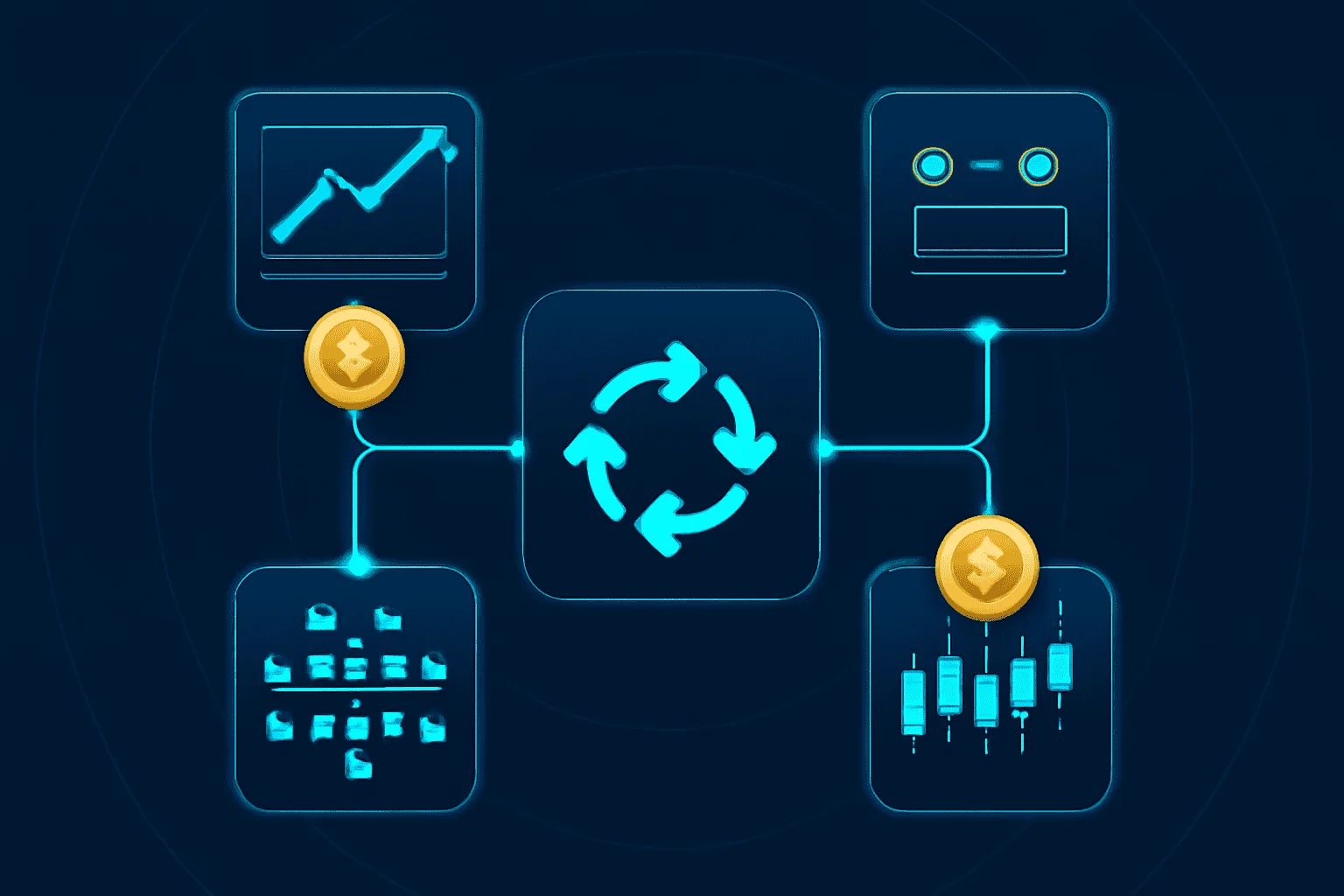
Under the hood, aggregators use smart contracts to batch, split, and route orders. They ping integrated DEXs and liquidity sources, benchmark quoted rates, estimate gas costs for each route, and then construct a transaction composed of one or several legs. This happens in seconds.
- Quote discovery: The aggregator requests token prices and available liquidity across integrated pools.
- Route computation: An algorithm scores potential paths by net output after fees, slippage, and gas.
- Order splitting: If one path isn’t optimal, the order may be divided across multiple pools.
- Execution: A smart contract executes the final route in a single transaction you approve.
- Settlement: You receive the output tokens in your wallet, minus protocol and network fees.
Routing logic varies. Some tools favor fewer hops to save gas. Others prioritize price improvement and accept extra steps. The best choice can change block by block as liquidity moves.
Why Traders Use Aggregators
Aggregators compress the fragmented DEX landscape into a single interface. Instead of checking five tabs and recalculating after gas, you see a unified quote. That convenience often translates into measurable savings, especially on larger trades or illiquid pairs.
- Better pricing: Access to more pools reduces price impact and improves the final rate.
- Lower slippage: Smart order splits can avoid draining a single shallow pool.
- Time saved: One interface, one approval pattern, fewer misclicks during volatile markets.
- Gas-aware routing: Some routes use fewer operations, cutting network costs.
- Extra sources: Many aggregators pull from on-chain RFQ (request-for-quote) market makers for tighter quotes.
For a micro-example: swapping 20,000 USDC to wstETH might be 0.8% worse on a single DEX due to thin liquidity. An aggregator could split across a Curve pool and a Balancer pool, drop slippage to 0.2%, and still keep gas reasonable by capping the number of hops.
Common Features You’ll See
Most leading aggregators share a core toolset, but implementation details differ. Knowing what’s on offer helps you read quotes with a critical eye.
| Feature | What it Does | Why it Matters |
|---|---|---|
| Multi-DEX routing | Combines liquidity from many AMMs and RFQ providers | Improves execution price and reduces slippage |
| Gas optimization | Estimates gas and weighs cheaper paths | Avoids routes that save on price but waste on fees |
| Slippage controls | User-set tolerance on price movement | Prevents unexpected losses in volatile blocks |
| Partial fills / RFQ | Off-chain quotes settled on-chain | Tighter spreads on popular pairs |
| Approvals management | Handles token allowances safely | Reduces failed transactions |
| MEV protection | Private transaction relays or batch auctions | Mitigates frontrunning and sandwich attacks |
If you often trade the same pair, pay attention to allowance prompts and approval spend limits. Setting unlimited approvals is convenient but increases risk if a contract gets compromised.
DEX vs. DEX Aggregator
Trading on a single DEX gives you direct access to its pool and fee schedule. That’s simple and predictable. The trade-off is price fragmentation—liquidity sits in many places. Aggregators shine when a pair routes better across two or more pools, or when gas-aware choices beat your manual guesswork.
On small swaps in blue-chip pairs, the difference may be tiny. On niche tokens or larger sizes, the gap can be material. A 0.3% improvement on a $50,000 swap is $150 saved before gas—a sum that adds up across months.
Risks and Trade-offs
Aggregators reduce search costs, not risk entirely. A few points deserve attention before you approve a route.
- Contract risk: You interact with the aggregator’s smart contracts. Audit status and track record matter.
- Hidden hops: Extra steps can add gas and complexity. Check the route preview before signing.
- Slippage settings: Too loose, and you invite poor execution; too tight, and your transaction reverts.
- Token quality: An aggregator can route into volatile or fee-on-transfer tokens. Verify the asset contract.
- MEV exposure: Public mempool routes can be sandwiched. Private relays reduce but don’t eliminate risk.
A quick sanity check helps: does the net output make sense versus a single-DEX quote? If the aggregator shows a dramatic improvement, confirm that the path and tokens are what you expect.
When a DEX Aggregator Excels
Some scenarios consistently favor aggregation. If you recognize these patterns, you’ll know when the extra routing pays off.
- Mid-to-large orders where price impact on a single pool would be noticeable.
- Pairs with liquidity split across AMM types (e.g., Uniswap V3 concentrated liquidity plus a Curve stable pool).
- Cross-chain or L2 routes where gas dynamics and liquidity differ sharply by network.
- Market spikes, when quotes stale rapidly and broader sourcing finds fresher liquidity.
For instance, swapping volatile governance tokens on a busy day can swing 1–2% between venues. A route that taps a V3 narrow range and a Balancer weighted pool can close that gap.
How to Evaluate an Aggregator
Beyond headline names, you can vet a service with a short checklist. A few minutes of due diligence protects your wallet and your execution quality.
- Security posture: Look for recent audits, bug bounties, and public incident reports.
- Route transparency: Clear previews of hops, fees, and estimated gas before you sign.
- MEV strategy: Support for private transactions or protection modes.
- Token lists and filters: Guardrails against malicious or illiquid tokens.
- Track record: On-chain volume, uptime, and community feedback.
Try a test swap with a small amount first. If the output and gas align with the preview, step up to your usual size.
Costs: What You Actually Pay
Your all-in cost is the difference between the gross quote and the final tokens received after protocol fees, LP fees, and gas. Aggregators sometimes charge a small service fee; some waive it on certain pairs or networks.
Two key levers sit with you. First, gas settings: fast confirmation reduces price drift, but overpaying on gas can erase price improvements. Second, slippage tolerance: set it narrowly for stable pairs, a bit wider for volatile assets, and avoid extremes unless necessary.
Practical Tips for Better Execution
Small habits improve outcomes and reduce headaches, especially when markets heat up.
- Keep token approvals tight and revoke unused allowances periodically.
- Compare at least one single-DEX quote to validate the aggregator’s edge.
- Mind L2 specifics: lower gas helps multi-hop routes shine on networks like Arbitrum or Base.
- Use MEV-protected modes for larger swaps when available.
- Double-check token contract addresses, especially for lookalike tickers.
On a Friday volatility spike, for example, bumping your gas slightly and using a private relay can prevent reverts and sandwiching, preserving your quoted output.
The Bottom Line on DEX Aggregators
A DEX aggregator streamlines on-chain trading by scanning many liquidity sources and constructing the best available route for your swap. The main benefits are better pricing, lower slippage, and time saved. The main risks are contract exposure, MEV, and the occasional gas-heavy path. With basic safeguards—route previews, sensible slippage, and security checks—you can capture the upside while keeping surprises rare.
Whether you swap once a week or rebalance daily, treating the aggregator as your default quote and then spot-checking against a single DEX is a simple, effective routine. Over a month of trading, those incremental gains are what most traders actually feel in their wallet balance.