DEX Explained: Stunning Guide to the Best Decentralized Exchanges
Contents
How a DEX Works
DEXs coordinate trades using code. Most of the activity centers on smart contracts that hold liquidity and execute swaps. Your wallet signs a transaction, the contract checks the terms, and—if the math works—assets move atomically. No account creation, no custodial risk, and no support ticket to withdraw funds.
Three main designs dominate today’s DEX landscape, each with different trade-offs and user experiences.
AMMs, Order Books, and RFQ: The Core Models
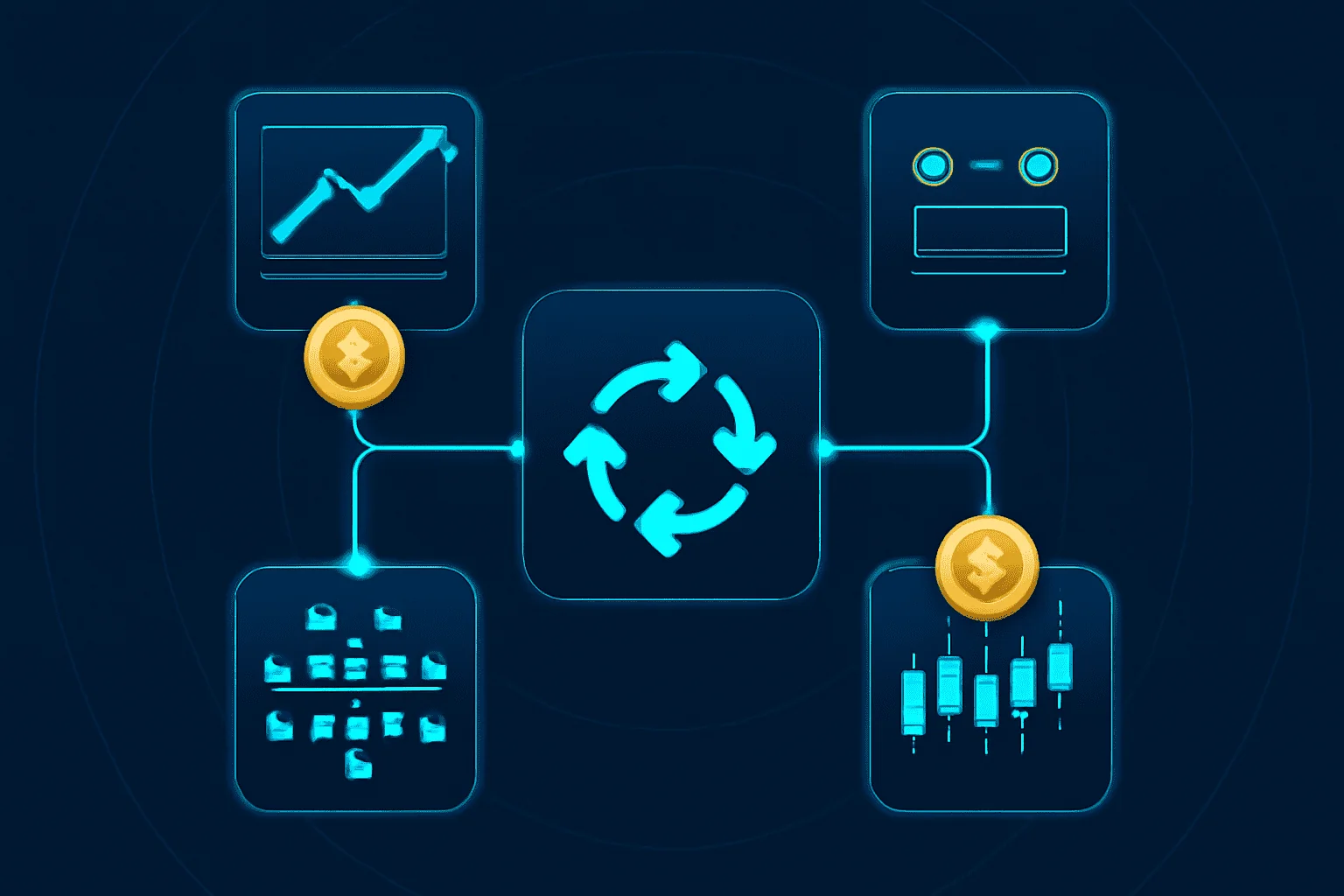
Automated Market Makers (AMMs) power most on-chain trading. Order books exist too, especially on high-throughput chains. Request-for-Quote (RFQ) systems bridge pro liquidity with on-chain settlement.
Automated Market Makers (AMMs)
AMMs use liquidity pools—token pairs deposited by users—to quote prices with a formula. The classic x·y=k model (popularized by Uniswap v2) adjusts price as trades change the ratio of tokens in the pool. Liquidity providers (LPs) earn trading fees, and sometimes token incentives, in exchange for taking on price exposure.
A quick mental model: imagine a USDC–ETH pool with equal value of each asset. When someone buys ETH from the pool, ETH gets scarcer and its price rises relative to USDC. The formula enforces that shift automatically.
Order Book DEXs
Order book DEXs resemble traditional exchanges. Traders place limit and market orders; a matching engine pairs buyers and sellers. On-chain order books exist, but they’re bandwidth-hungry. Many modern designs keep orders off-chain for speed and settle filled trades on-chain for auditability.
RFQ and Aggregators
RFQ systems fetch quotes from market makers, who commit to a price for a short window. When the user accepts, settlement happens on-chain. Aggregators like 1inch or Matcha route orders across pools and makers, chasing the best price and lowest slippage. In practice, many retail traders use an aggregator as their default interface.
Key Benefits of Using a DEX
DEXs trade convenience for control. The balance suits people who want custody and transparency above all else.
- Self-custody by default: you hold keys, you hold funds.
- Global access with a wallet: no account approval or withdrawal limits.
- Transparent rules: pricing and fees live in open-source contracts.
- Composability: integrate swaps into wallets, bots, or dApps with a few calls.
- Token coverage: long-tail assets often list on DEXs before centralized venues.
For example, a small DAO can list its governance token by seeding a pool, set a fee tier, and bootstrap a market in minutes. No listing committee. No market maker retainer.
Risks and Drawbacks to Watch
Control also means responsibility. Risk surfaces shift from counterparty risk to contract and market structure risk.
- Smart contract bugs: a flawed pool or router can be drained if exploited.
- Impermanent loss: LPs can underperform simply holding the assets when prices diverge.
- Slippage and MEV: large orders may move the price; searchers can reorder transactions to capture value.
- Fake tokens and approvals: anyone can deploy a token; careless approvals can grant token spend rights.
- Network congestion: during volatility, gas fees spike and transactions can fail or get stuck.
Imagine swapping a new token during a hype window. Gas jumps, the mempool clogs, and a slow confirmation exposes your trade to frontrunning. Using a higher gas priority or a private relay can reduce that risk, but it cannot erase it.
What You Need to Use a DEX
Getting started takes a few pieces of infrastructure and a small dose of operational hygiene.
- A self-custody wallet (e.g., MetaMask, Rabby, Trust Wallet) with a funded address.
- Gas token for the network you’re using (ETH for Ethereum, MATIC for Polygon, etc.).
- Familiarity with slippage settings, approvals, and revoking allowances.
- Awareness of the chain’s bridge options if moving funds cross-chain.
Always verify the token contract address from a reputable source. On-chain data explorers list contract addresses; many DEX UIs also flag verified tokens. Don’t rely on a token name alone—imitators often use lookalike tickers.
Popular DEX Types Across Ecosystems
Different chains favor different designs based on throughput and fees. The table below highlights common approaches seen across networks.
DEX Models by Chain: Quick Overview
| Model | How Pricing Works | Strength | Typical Chains |
|---|---|---|---|
| Constant Product AMM | x·y=k curve adjusts price as pool balances change | Simple, reliable, deep token coverage | Ethereum, BNB Chain, Polygon |
| Concentrated Liquidity AMM | LPs choose price ranges to deploy liquidity | Capital efficiency, tighter spreads | Ethereum, Arbitrum, Base |
| StableSwap AMM | Custom curve optimized for like-kind assets | Low slippage for stable pairs | Multiple L1s and L2s |
| On-Chain Order Book | Limit/market orders recorded and matched | Precise control for traders | Solana, Sui, Near |
| RFQ/Aggregator | Quotes from makers; best-route execution | Better prices, less slippage on large swaps | Multi-chain |
Designs keep evolving. Concentrated liquidity, for instance, changed how LPs think about “being the market,” shifting from passive pools to active range management with rebalancing strategies.
Fees, Price Impact, and Execution Quality
Total cost to trade on a DEX includes more than the visible swap fee. You also pay network fees and bear any price impact from the pool’s depth. Aggregators estimate these in advance, but estimates can drift if the market moves during confirmation.
Three practical tips improve outcomes:
- Check pool depth and route: deeper pools reduce slippage; multi-hop routes may be cheaper.
- Set a tight but realistic slippage tolerance in volatile markets.
- Use gas settings that match urgency; low priority invites reordering or stale quotes.
A small stablecoin swap on a deep pool often clears for a few cents on an L2. A large altcoin trade on mainnet can cost much more in both gas and price impact. Size accordingly.
Providing Liquidity: Rewards and Risks
Liquidity providers supply the inventory traders interact with. In return, they earn a share of fees and possibly protocol incentives. The catch is impermanent loss: when the price of one asset moves relative to the other, LP value can lag simple holding.
With concentrated liquidity AMMs, LPs choose price bands. Narrow bands earn more fees when in-range but go idle when price leaves the range, turning the position into a one-sided asset exposure. Active management—rebalancing and fee harvesting—becomes part of the strategy.
Security Habits That Actually Help
Simple routines reduce common pitfalls.
- Use a hardware wallet for larger balances; keep a burner wallet for experimental tokens.
- Review and limit token approvals; regularly revoke unused allowances via a trusted tool.
- Bookmark official DEX URLs; avoid links from group chats and trending posts.
- Cross-check token contracts on an explorer before approving any swap.
A practical flow: fund a fresh address with gas, test a tiny swap, then scale size once the route and costs look sane. This saves headaches when a token has transfer taxes or odd permissions.
Where DEXs Are Heading
New designs push execution quality closer to centralized exchanges while keeping self-custody. Intent-based trading, private mempools, and on-chain derivatives are gaining ground. Cross-chain liquidity will likely feel more unified as message layers mature, so swapping an asset on one chain using liquidity from another becomes routine.
What remains constant: a DEX is code that lets peers trade without surrendering their keys. If that property matters to you, learning the basics—approvals, slippage, gas, and verification—pays off quickly.