
Contents
Rollups in one sentence
Both types bundle many transactions into a single batch, execute them off-chain, and submit proof and data to Ethereum for finality and data availability.
Core difference at a glance
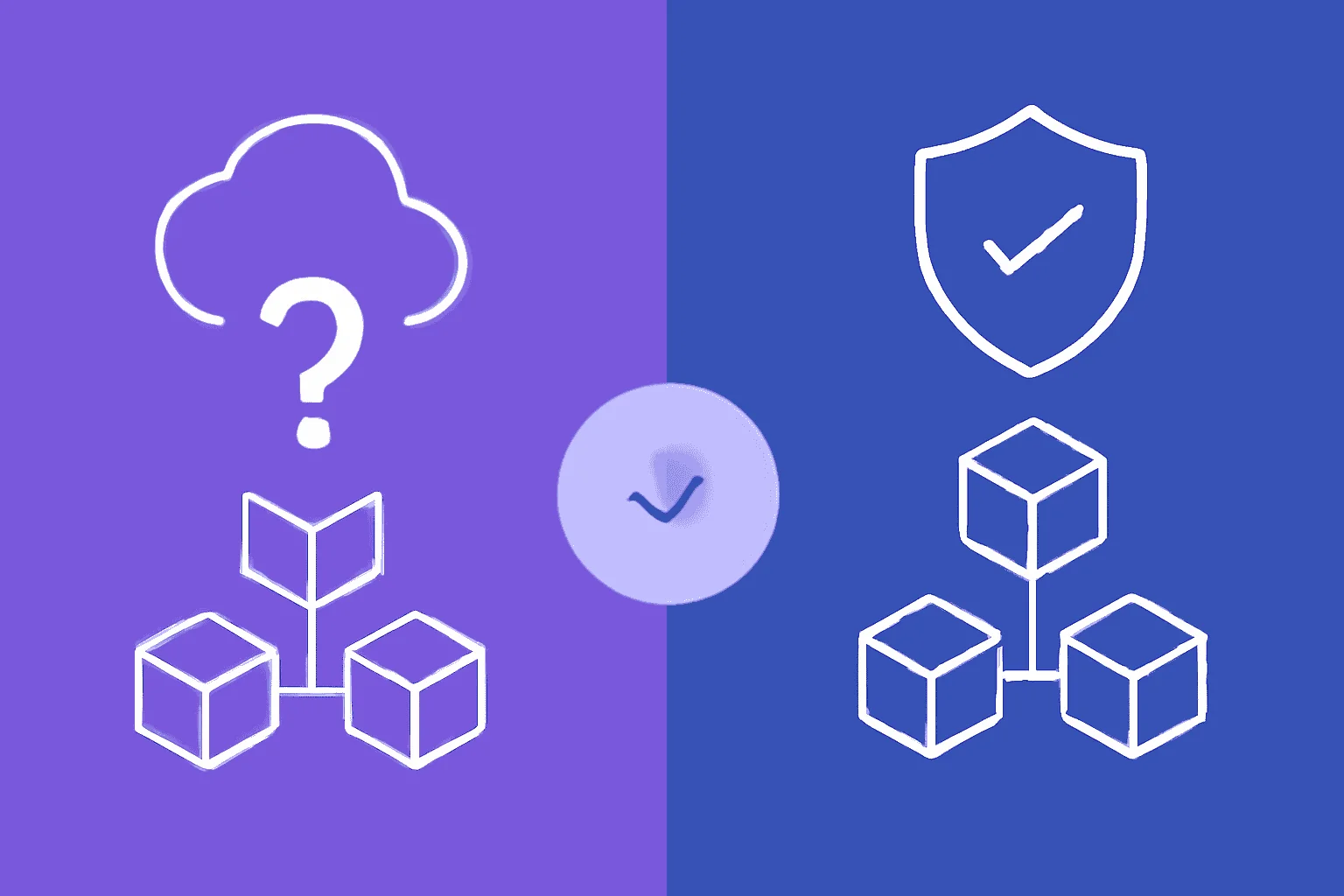
Optimistic Rollups assume batches are valid unless challenged within a window; ZK-Rollups prove every batch’s correctness up front using cryptographic proofs. That single design decision shapes speed, cost, security assumptions, and developer experience.
How Optimistic Rollups work
Optimistic systems like Optimism and Arbitrum publish transaction data to Ethereum and “optimistically” treat state transitions as correct. If anyone suspects fraud, they can post a fraud proof during a dispute window (often 7 days). The protocol re-runs the disputed computation on-chain to verify the claim.
Think of it as a public challenge game. Most batches pass unchallenged, which keeps costs low. The catch is withdrawals from L2 to L1 wait for the challenge period to expire, unless a liquidity provider fronts the funds.
How ZK-Rollups work
ZK systems such as zkSync Era, Starknet, and Scroll generate validity proofs—SNARKs or STARKs—that mathematically attest a batch was computed correctly. Ethereum verifies the proof quickly, which finalizes the batch without a dispute window.
The heavy work happens off-chain: constructing proofs is computationally intensive and requires specialized circuits. Once built, though, the on-chain verification is fast and cheap per transaction.
Finality and withdrawals
Finality is where users feel the difference. With Optimistic Rollups, economic finality comes after the challenge window. With ZK-Rollups, finality lands as soon as the proof is verified on Ethereum, often minutes after submission.
- Optimistic: quick confirmations on L2, slow trustless withdrawals to L1 unless you use a bridge that fronts liquidity.
- ZK: slightly slower batch production when proofs are being generated, but trustless withdrawals are fast after verification.
In practice, traders use L2 confirmations for UX and rely on fast bridges for exit liquidity. Long-tail users moving funds back to self-custody on L1 notice the difference most.
Security model and attack surfaces
Both inherit Ethereum’s data availability. The divergence is in how they enforce correctness.
- Optimistic: security depends on at least one honest party monitoring and submitting fraud proofs within the window. If no one challenges a bad batch, it stands.
- ZK: security depends on the soundness of the proof system, correct circuit design, and the absence of toxic setup issues (for SNARKs that use a trusted setup).
Micro-scenario: a malicious sequencer tries to include an invalid state transition. On an Optimistic Rollup, a watcher must catch it and prove fraud. On a ZK-Rollup, the batch never verifies because the proof won’t validate on L1.
Costs, throughput, and fees
Fees come from two buckets: L2 computation and L1 data publishing. Optimistic Rollups avoid proof-generation costs but pay full L1 data costs. ZK-Rollups pay for proof generation but amortize it across many transactions and benefit from cheap L1 verification.
As data compression improves (e.g., calldata to blobs via EIP-4844), both see lower fees. ZK systems often gain more from batching due to proof amortization, especially for simple transfers and swaps.
Developer experience and EVM compatibility
Optimistic Rollups launched earlier with strong EVM equivalence, easing contract migration. Arbitrum and Optimism run familiar tooling and bytecode, so deploying an ERC-20 or an AMM feels routine.
ZK-Rollups historically used custom VMs tailored for proving (Cairo for Starknet). Newer ZK-EVMs (Polygon zkEVM, Scroll, zkSync’s Era with Solidity-level support) narrow the gap. The trade-off: perfect EVM equivalence can increase proving complexity; near-equivalence simplifies proofs but may need edge-case adjustments.
User experience: delays, bridges, and MEV
On Optimistic Rollups, native withdrawals wait days. Users often choose third-party bridges for near-instant exits, accepting bridge risk. On ZK-Rollups, native exits finalize quickly after proof verification. For cross-rollup moves, bridge design matters more than rollup type.
Sequencing and MEV policies vary. Some projects are introducing shared sequencing or enshrined decentralization to reduce censorship and improve fairness. Expect both families to converge on similar MEV mitigation over time.
When each approach shines
Both can support DeFi, gaming, payments, and NFT apps. The best fit depends on your constraints.
- Optimistic Rollups: straightforward Solidity porting, mature tooling, low proving overhead. Good for teams prioritizing immediate EVM parity and ecosystem liquidity.
- ZK-Rollups: fast finality to L1, strong security guarantees via validity proofs, efficient batched verification. Attractive for payment rails, high-frequency trading, and privacy-adjacent designs.
A web game that rarely exits to L1 may prefer Optimistic for ease and cost stability. A payment processor settling many small transfers might favor ZK for speedy, trustless finality.
Key technical contrasts
The table below summarizes major differences developers and users notice day to day.
| Dimension | Optimistic Rollups | ZK-Rollups |
|---|---|---|
| Validity model | Assume valid; challenge via fraud proofs | Prove valid up front (SNARK/STARK) |
| Finality to L1 | After dispute window (days) | After proof verification (minutes) |
| Withdrawals | Slow trustless; fast via bridges | Fast trustless post-proof |
| EVM compatibility | High (equivalence on major stacks) | Improving (ZK-EVMs, some caveats) |
| Cost drivers | L1 data costs; no proof cost | Proof generation + L1 data |
| Security assumption | At least one honest watcher | Soundness of proof system/circuits |
| Prover complexity | Low | High; specialized hardware/software |
These aren’t static. EIPs that reduce data costs and next-gen provers will keep shifting the balance, especially for ZK systems.
Data availability and the role of Ethereum
Both designs post transaction data to Ethereum to preserve the ability to reconstruct state. That’s what lets users exit even if a sequencer disappears. Some teams explore alternative data availability (DA) layers to cut costs, but that introduces new trust and recovery assumptions. For strict Ethereum security, on-chain DA remains the benchmark.
What’s changing in 2025
Two trends stand out: cheaper data and faster proofs. Danksharding’s roadmap and more efficient blob usage lower fees across the board. On the ZK side, recursive proofs and hardware acceleration are slashing proving times, enabling higher throughput without ballooning costs. Meanwhile, Optimistic Rollups are tightening fraud proof implementations and decentralizing sequencers, shrinking the operational risk surface.
Choosing between them: a quick checklist
If you’re evaluating where to deploy or which L2 to use, align the rollup’s strengths with your needs. Use the following as a practical filter.
- Do you need fast, trustless withdrawals to L1 for your flow of funds? If yes, lean ZK.
- Is perfect EVM equivalence and mature tooling non-negotiable for your team today? If yes, lean Optimistic or a proven ZK-EVM with equivalence.
- Will most users stay on L2, with rare exits? Either works; compare fees, liquidity, and ecosystem integrations.
- Are you building high-frequency payments or intent-heavy trading? ZK finality and batching can shine.
- Do you rely on third-party bridges anyway for UX? The withdrawal difference matters less; weigh security track records and governance.
Run a small pilot on both if possible. Measure latency, fees, and edge-case behavior under load—like mass liquidations or NFT mints—before committing.
Bottom line for readers
Optimistic Rollups bet on economic incentives and post-challenge security; ZK-Rollups bet on cryptography and immediate validity. Neither is “better” across the board, but their trade-offs are crisp. If you want instant finality to Ethereum and can handle the proving stack, ZK is compelling. If you want battle-tested EVM parity and simple operations today, Optimistic is still a strong default.